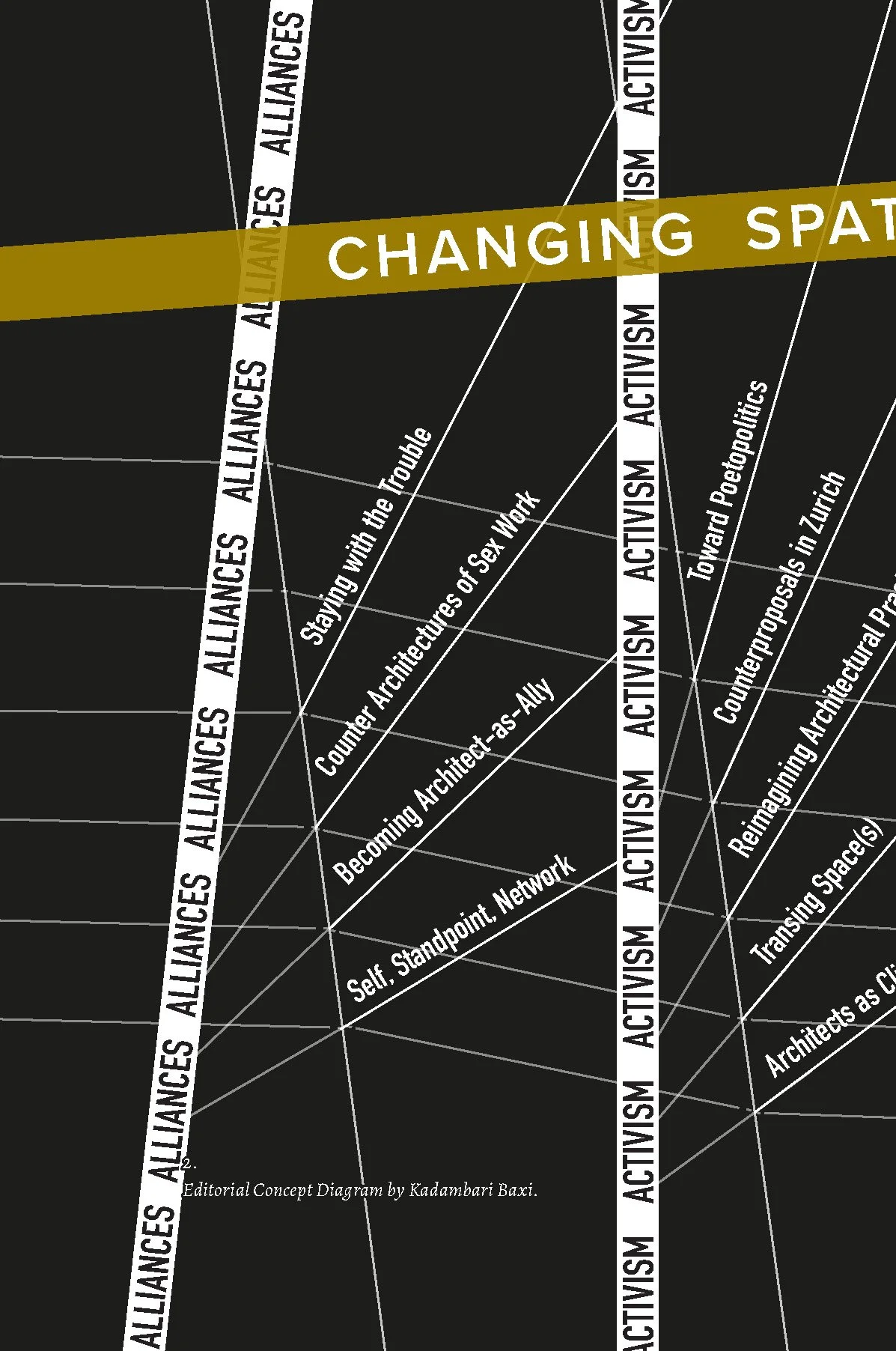
Editorial Concept Diagram by Kadambari Baxi
Self, Standpoint, Network
Ed. by Kadambari Baxi, Isabel Glogar, Gabu Heindl, Bernadette Krejs, and Tatjana Schneider
2024
Abstract:
»Revealing one’s subjective self and standpoint increasingly is treasured in ethnography as well as the reproductive justice movement because we actually challenge the omnipresent, allegedly neutral voice that distances itself from the objects of the discourse« -Loretta Ross
This essay addresses political threats to reproductive bodily autonomy vis-à-vis the built environment and speculates how the intersectional, feminist perspective of Reproductive Justice, a human rights framework calling for bodily autonomy, reproductive freedom, and sustainable communities founded by a coalition of Black women in 1994, could transform architecture into a more politically engaged and socially imaginative discipline. In contrast to the objective neutrality of conventional design practice, this framework draws from self-awareness of individual needs in collective contexts to care for others and build sustainable futures. To become more supportive of real, diverse human bodies and lived experiences, architecture can adopt autoethnographic methods which draw from personal experience to address oppression and build common grounds.
The autoethnography of Reproductive Justice is explored through the lenses of self (an individual's immediate, personal experience), standpoint (the perspective shaped in relation to larger societal contexts), and network (the broader interconnected social and environmental relationships). A case study of recent academic design studios addressing Reproductive Justice and the built environment amid increasing threats and restrictions to reproductive healthcare in the US demonstrates how designers can draw from their own experiences to establish consideration for others’ and embrace the interconnectedness of all three scales in imagining architectures of reproductive justice and sustainability.